Samsung Rebound Erases KOSPI Losses as KOSDAQ ADR Plunges to 46
The domestic equity market experienced a highly turbulent session on Tuesday, defined by a dramatic intraday tug-of-war between systemic profit-taking and mega-cap index defense.
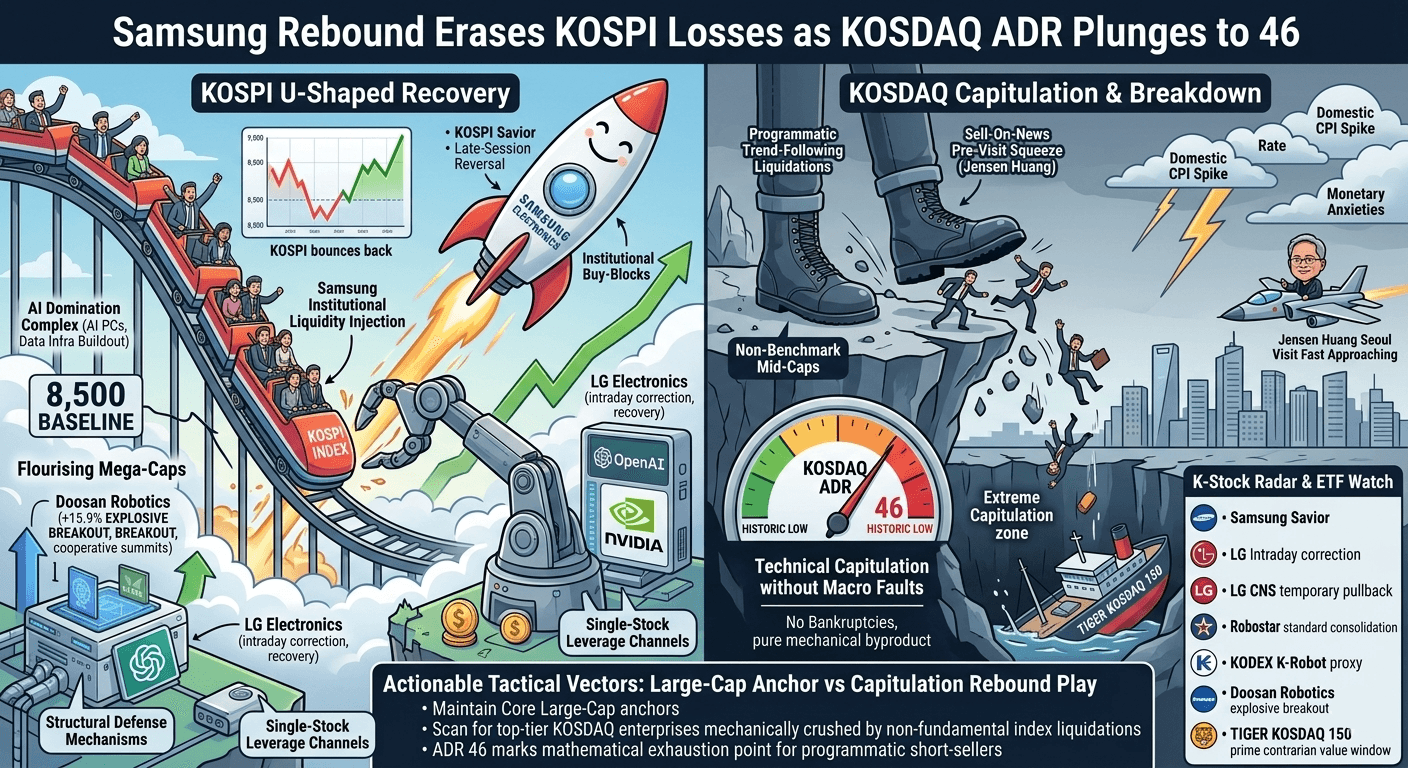
The benchmark KOSPI successfully pulled off a late-afternoon U-shaped recovery, closing in positive territory thanks to a massive liquidity injection into Samsung Electronics. Conversely, the junior KOSDAQ extended its agonizing losing streak to five consecutive sessions, cascading by more than -2% daily into an absolute technical capitulation zone.
The trading floor was initially hit by massive structural headwinds as foreign institutional desks unloaded enormous blocks of tech hardware and automotive lines, totaling over 6.2 trillion KRW in net KOSPI selling. While individual retail participants stepped in aggressively to absorb the avalanche of corporate supply, the sheer velocity of programmatic trend-following liquidations heavily punished mid-cap growth equities.
However, beneath the heavy surface selling, a powerful domestic structural defense mechanistically kicked into gear. Institutional buying blocks and passive equity programs successfully defended the KOSPI 8,500 baseline, utilizing the massive single-stock leverage channels to cushion the broader index from structural damage.
1. The Macro Backdrop: Domestic CPI Spikes, Rate Fears, and Geopolitical De-escalation
The global and domestic macroeconomic landscape presented a collection of intense cross-currents, rapidly shifting investor focus back toward interest rate trajectories and sovereign inflation metrics:
- The Domestic CPI Shock & BOK Rate Pressures: The most immediate fundamental drag stemmed from a sharper-than-expected spike in South Korea’s latest Consumer Price Index (CPI) reading. Fueled by prolonged exposure to elevated international energy imports, the sudden inflationary jump severely reignited domestic monetary anxieties. Market participants aggressively re-priced the possibility of near-term monetary tightening, tracking prior hawkish commentary from the Bank of Korea’s Monetary Policy Committee and sending shockwaves through rate-sensitive growth sectors.
- The Hormuz Strait Friction and Trump’s Intervention: Global energy markets flared up early in the session after Iranian diplomatic channels announced a formal halt to ongoing end-of-war negotiations with Washington, citing continued military frictions in Lebanon. Tehran’s explicit threats to impose strict blockades across the critical Straits of Hormuz and Bab-el-Mandeb sent WTI crude spiking above the $90 threshold. However, the immediate geopolitical premium eased rapidly following a decisive phone call between Donald Trump and Israeli Prime Minister Benjamin Netanyahu, which reportedly led to the immediate cancellation of planned retaliatory airstrikes. This political de-escalation neutralized an immediate maritime oil crisis, steering capital back toward micro-level corporate fundamentals.
2. The Structural Catalyst Complex: ‘Sell-on-News’ Volatility and Extreme ADR Extremes
The overarching structural theme of the day centered on the classic “sell-on-news” behavioral phenomenon alongside a mechanical depletion of secondary board liquidity:
The Jensen Huang Pre-Visit Squeeze
With Nvidia CEO Jensen Huang’s high-profile Seoul visit fast approaching, the aggressive speculative momentum that had propelled mega-cap technology lines over the past two trading sessions faced a sharp fundamental check. Technology desks experienced a widespread wave of tactical profit-taking as short-term institutional allocators locked in gains to mitigate immediate downside volatility.
Instruments that had logged parabolic ascents over the prior 48 hours—such as LG Electronics—faced deep intraday corrections as traders actively managed risk against a potential “sell-on-the-news” capitulation upon the executive’s physical arrival.
The Historic KOSDAQ ADR Breakdown
The mechanical bifurcation of the market reached its absolute historical threshold. The KOSDAQ Advance-Decline Ratio (ADR) fundamentally broken below yesterday’s floor to hit an unprecedented low of 46.
Historically, the domestic junior board has never maintained a technical trajectory below the 46 baseline without an absolute global macro economic collapse. While the lack of corporate bankruptcies or credit failures confirms that this severe -10% vertical multi-day drop is entirely a structural byproduct of severe large-cap portfolio migration, the absence of defensive capital or clear policy interventions left non-benchmark mid-caps completely exposed to programmatic downside momentum.
3. The AI and Physical Automation Complex: Cross-Currents in Tech
Despite the widespread profit-taking wave shaking down primary hardware suppliers, the structural secular narrative surrounding next-generation artificial intelligence continued to expand rapidly into diversified end-markets:
The AI PC Evolution
Global tech architecture found a massive structural catalyst in Nvidia’s latest strategic commentary detailing the imminent proliferation of localized AI PCs. This macro shift provides immense long-term fundamental visibility for South Korean memory fabricators, as local architectures are primed to secure highly lucrative, high-margin systemic components required to power edge-computing AI configurations.
Physical AI and Strategic Enterprise IPOs
The thematic focus over the session sharply rotated away from pure-play semiconductor memory into next-generation physical automation platforms. As validated by recent corporate data, Nvidia is actively expanding its strategic touchpoints into agile domestic robotics startups, searching for high-conviction physical AI optimization partners.
Simultaneously, the broader tech ecosystem received an immense long-term confidence boost following Alphabet’s massive 80 billion dollar capital expansion program—with Berkshire Hathaway directly anchoring a 10 billion dollar tranche—securing a massive runway for the global AI data infrastructure buildout.
K-Stock Radar & ETF Watch: Today’s High-Conviction Seven
The following single-point interactive tracker monitors the seven core instruments currently commanding the exchange’s absolute liquidity, policy backings, and thematic momentum.
1. Samsung Electronics (005930)
Operated as the absolute index savior of the trading session. Despite facing heavy morning institutional selling, massive late-afternoon domestic defensive flows flooded its order book, pushing the stock into a positive reversal and single-handedly insulating the KOSPI from an extended technical breakdown.
2. LG Electronics (066570)
Endured intense intraday volatility as short-term momentum desks aggressively took profits following its historic 50% multi-day rally. However, a powerful late-session institutional block buy stepped in at the lower support boundaries, driving a robust end-of-day recovery.
3. LG Co. / LG CNS (003550)
Faced a temporary technical pullback as part of the broader holding-company and conglomerate profit-taking cycle. Despite the near-term volatility, long-term systematic allocators continue to monitor its structural position as the absolute core software engine powering the group’s enterprise AI roadmap.
4. Robostar (090360)
Maintained its high-conviction status within the physical automation stack. While undergoing standard healthy consolidation after yesterday’s parabolic move, its absolute equity alignment with the LG Group’s smart factory rollout keeps it front and center for upcoming cross-border AI partnerships.
5. KODEX K-Robot Active ETF (441680)
Absorbed heavy thematic trading volume as capital aggressively rotated into the automation sector. Backed by expanding expectations surrounding Jensen Huang’s upcoming tour of localized robotic facilities and OpenAI’s hardware alignments, this vehicle served as the primary diversified proxy for physical AI.
6. Doosan Robotics (273130)
Staged an explosive +15.9% breakout session, completely bucking the broader market downturn. The massive capital influx was triggered by confirmed enterprise news detailing high-level cooperative summits with top-tier AI tech founders, cementing its dominant position in international collaborative robotics.
7. TIGER KOSDAQ 150 (232080)
Sustained intense systemic selling pressure as the junior index ADR capitulated down to the historic 46 milestone. With the underlying growth index experiencing an unprecedented 5-day consecutive -2% cascade purely due to programmatic liquidity drains, it occupies a prime contrarian value window.
Strategic Summary: The structural divergence between an artificially defended KOSPI and a historically oversold KOSDAQ has reached an absolute technical extreme. With the KOSDAQ ADR striking a terminal floor of 46—a depth never sustained in modern market history without systemic macro failure—the current panic has crossed deep into non-fundamental territory.
- Actionable Tactical Vectors:
- The Large-Cap Anchor: Maintain defensive long positioning inside core index anchors like Samsung Electronics to capitalize on institutional benchmark defense, while selectively using high-beta vehicles to trade the extreme intraday swings of frontline AI leaders.
- The Capitulation Rebound Play: Do not participate in late-stage panic liquidations across mid-cap growth segments. Historically, an ADR reading of 46 marks an absolute mathematical exhaustion point for programmatic short-sellers. Institutional allocators should actively scan for top-tier KOSDAQ enterprises that boast stellar Q1 earnings execution but have been mechanically crushed by non-fundamental index liquidations, preparing to deploy capital ahead of a violent mean-reversion wave.


Leave a Reply