Overview: Five Consecutive Declines, Semiconductors Lead the Selloff
U.S. equity markets closed lower on Friday, June 26, as semiconductor stocks bore the brunt of selling pressure triggered by reports that OpenAI is considering delaying its IPO. The NASDAQ Composite and S&P 500 extended their losing streak to five consecutive sessions, though the damage was contained by meaningful strength in healthcare and software. Consumer discretionary, real estate, utilities, and financials also managed to close in positive territory, providing some cushion to an otherwise soft tape.
The OpenAI IPO Delay: A Stone Dropped into Still Water
The session’s defining theme was a news report suggesting OpenAI is reconsidering the timing of its public listing. The company apparently concluded that achieving a $1 trillion valuation in the current market environment would be difficult — a sober reassessment that sent ripples through the entire AI infrastructure complex.
One critical data point behind this calculation: SpaceX’s own IPO process resulted in post-listing share price weakness, and that outcome appears to have weighed heavily on OpenAI’s decision-making. If a marquee name like SpaceX struggled to sustain its valuation premium after coming to market, OpenAI’s board clearly sees little advantage in rushing.
The market read this as a potential signal of slowing capital deployment into AI infrastructure. JPMorgan warned that a delayed capital raise calls into question the sustainability of infrastructure investment. Adam Crisafulli echoed similar concerns, noting that the pace of AI-related capital spending could decelerate if primary market funding gets pushed out.
The collateral damage extended well beyond chip stocks. Oracle — one of the most visible beneficiaries of large-scale OpenAI infrastructure contracts — fell sharply on the week, posting a decline of approximately 19%. That is the stock’s worst weekly performance since the dot-com bust, and the market is now pricing in genuine concern about whether those contracted deployments will proceed on schedule. Data center-related names tracked lower in sympathy.
Even the investment banks managing the anticipated offering — Morgan Stanley and Goldman Sachs among them — traded weaker on the day. The irony is not lost: when an IPO gets delayed, even the underwriters feel the cost.
There is, however, a counterargument worth considering. Some analysts framed the delay as a net positive for market liquidity. During SpaceX’s listing process, semiconductor stocks were reportedly used as a source of funds — investors liquidating chip positions to participate in the IPO. If OpenAI’s listing is pushed back, that overhang is removed, which could take some near-term selling pressure off semiconductors. One concern eliminated, even if a larger question lingers.
Rates: PCE in Line, But the Gap to Target Remains Uncomfortable
Thursday’s PCE data came in broadly in line with expectations, but the absolute level — running above 4% on an annualized basis — remains far from the Federal Reserve’s 2% objective. That gap keeps the door open to further rate increases, and equity markets, particularly tech and data center names, have not fully priced out that risk.
For companies that rely on corporate bond issuance to fund their capital expenditure plans, a higher-for-longer rate environment is a genuine headwind. The market is not simply asking whether rates go up — it is asking why they might go up, and what that signal says about the trajectory of the broader economy.
On Friday, however, a decline in crude oil prices pulled Treasury yields lower, offering some relief. It was a temporary reprieve rather than a structural shift, but it helped limit the session’s downside.
Micron: The Street Remains Constructive Despite the Noise
Micron Technology came under pressure alongside its semiconductor peers, but the underlying analyst narrative remains broadly positive. A notable structural shift has been underway in how Micron contracts its business — moving from one-year agreements to five-year contracts with key customers. This change in contract duration meaningfully alters the cyclical risk profile of the business. Yahoo Finance highlighted this evolution as a source of earnings stability that the traditional semiconductor cycle model does not adequately capture.
Baird added a note of tactical caution, suggesting that semiconductors have run far enough that rotation into other sectors is possible through July. But the firm’s long-term conviction on AI infrastructure names, including memory, remains intact. In my experience, the market rarely gives you the clean entry you are waiting for — and these pullbacks, frustrating as they are, have historically been the moments where meaningful positions get built.
Healthcare: The Week’s Standout Performer
Healthcare was the clear winner of the week, with the sector index rising approximately 7% — the largest weekly advance since June 2022. Fresh buying interest flowed into the space on Friday, sustaining momentum into the close. Moderna provided a positive catalyst, announcing a pipeline strategy centered on mRNA-based oncology therapeutics. The market responded favorably to the clarity of direction.
Stock-Specific Notes: Apple, Microsoft, SpaceX
Apple bounced after yesterday’s broad market decline. Evercore maintained its price target despite expectations of price increases on select products, noting that iPhone price hikes are not anticipated until September at the earliest. iPad demand softness remains a concern, but the core iPhone franchise appears resilient enough to absorb near-term pressure.
Microsoft caught a bid on news that Michael Burry — of “The Big Short” fame — has taken a position in the stock via call options expiring in December 2028. Burry’s long-dated structure signals conviction rather than a tactical trade, and the market took notice.
SpaceX was added to the Russell index, triggering estimated rebalancing inflows of approximately $3 billion. The stock closed modestly higher on the session — a measured reaction, given that index-driven flows are mechanical rather than fundamental.
Broader Market Perspective: Volatility, Sentiment, and Seasonality
New York Life observed that the current semiconductor rally has been accompanied by notably higher volatility compared to the Magnificent Seven-led advance of prior cycles. That is worth monitoring. Volatility in a leadership group is often an early signal that the composition of the rally is about to change.
Goldman Sachs, meanwhile, struck a more constructive tone on the near term, arguing that despite current volatility, a short-term bounce is likely. Their reasoning: retail investors have been remarkably consistent in buying dips throughout 2025. Every correction has attracted fresh demand, and Goldman believes this behavioral pattern creates the conditions for another leg higher — potentially breaking through the 8,000 level on the S&P 500.
The University of Michigan’s final June consumer sentiment reading came in at 49.5, marginally above the 49.0 consensus. One-year inflation expectations eased slightly to 4.6%, down 0.2 percentage points from May. Not a dramatic move, but directionally constructive.
On the seasonal front, U.S. equities have historically shown weakness in the second half of June, followed by a recovery into month-end and the first half of July. The mechanism is typically institutional rebalancing at the half-year mark. This year’s price action appears to be tracking that seasonal pattern with reasonable fidelity — which does not guarantee a bounce, but does suggest that patience at current levels has historical precedent on its side.
Implications for Korean Markets
The MSCI Korea Index closed down 3.77% on the session, and Korean equity night futures were indicating an additional decline of 0.57% heading into the following week. Given that Korean exports — and Korean equities — are deeply linked to global semiconductor capex cycles, any prolonged uncertainty around AI infrastructure spending is a direct headwind for KOSPI names with exposure to memory, foundry, and equipment — most notably Samsung Electronics and SK Hynix.
That said, the structural demand thesis for advanced memory has not changed. The question is timing and sequencing, not direction. As someone who has watched this market through multiple cycles — the Asian financial crisis, the dot-com correction, the global financial crisis, COVID — I would caution against reading too much into a week’s worth of noise. The underlying demand for compute, and the memory that powers it, remains one of the most durable investment themes of this decade. Position accordingly, but manage your risk.
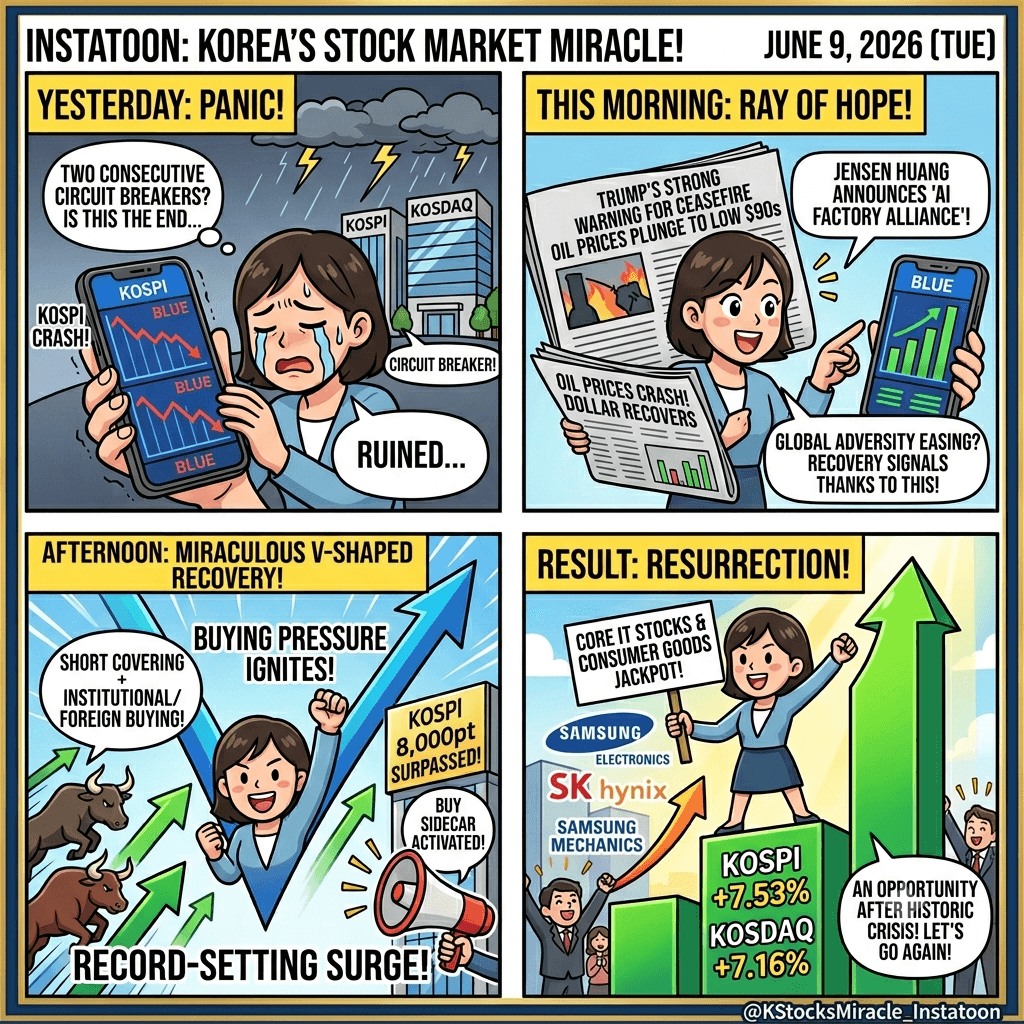
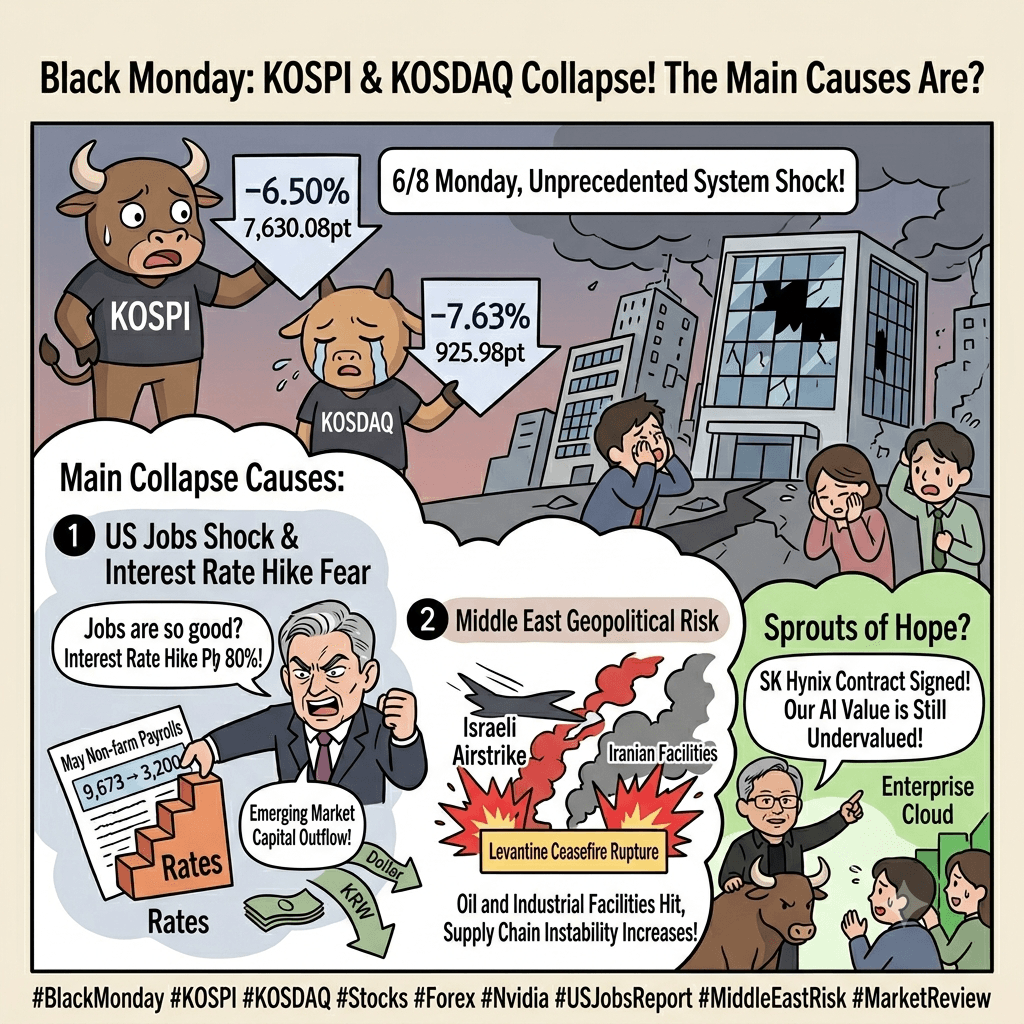
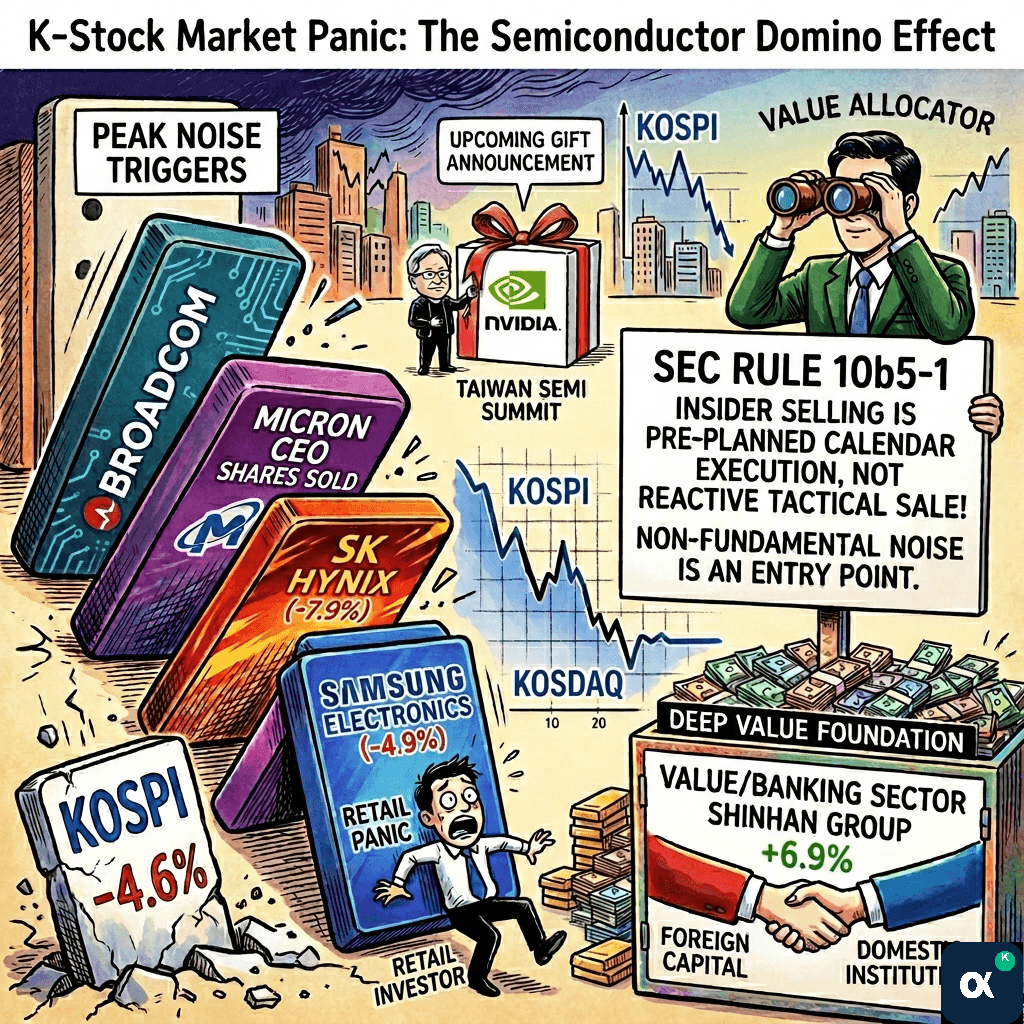
Related reading: For context on how semiconductor-led selloffs have played out in recent sessions, see Semiconductor Peak Noise Triggers -4.6% KOSPI Panic and the broader macro picture covered in Dual Circuit Breakers Paralyze K-Stocks. Earlier in the cycle, KOSPI Hit All-Time High as KOSDAQ ADR Drops Below 50 — a reminder of how quickly sentiment can shift when rate and valuation pressures converge.